 Add to Chrome
 Add to Firefox
 Add to Edge
A Decentralized LiDAR-SLAM System with Certifiably Optimal Pose Graph Optimization
May 24, 2026
Decentralized multi-robot LiDAR-SLAM is essential for collaborative missions but faces significant challenges in maintaining global consistency. Existing frameworks predominantly rely on local-search optimization or one-time coordinate alignment, which are prone to suboptimal convergence and long-term inconsistency, especially in large-scale or degenerate environments. To address these limitations, this paper presents the first decentralized LiDAR-SLAM system that integrates a state-of-the-art certifiably optimal Pose Graph Optimization (PGO) backend. By leveraging the Riemannian Block Coordinate Descent (RBCD) algorithm, our system ensures globally consistent trajectory estimation without requiring accurate initial guesses. Experimental results demonstrate that the proposed framework achieves superior robustness, improving trajectory RMSE by up to 48.9% compared to the state-of-the-art DiSCo-SLAM.

Chinese-SkillSpan: A Span-Level Dataset for ESCO-Aligned Competency Extraction from Chinese Job Ads
Apr 24, 2026Job Skill Named Entity Recognition (JobSkillNER) aims to automatically extract key skill information from large-scale job posting data, which is important for improving talent-market matching efficiency and supporting personalized employment services. To the best of our knowledge, this work presents the first Chinese JobSkillNER dataset for recruitment texts. We propose annotation guidelines tailored to Chinese job postings and an LLM-empowered Macro-Micro collaborative annotation pipeline. The pipeline leverages the contextual understanding ability of large language models (LLMs) for initial annotation and then refines the results through expert sentence-level adjudication. Using this pipeline, we annotate more than 20,000 instances collected from four major recruitment platforms over the period 2014-2025. Based on these efforts, we release Chinese-SkillSpan, the first Chinese JobSkillNER dataset aligned with the ESCO occupational skill standard across four dimensions: knowledge, skill, transversal competence, and language competence (LSKT). Experimental results show that the dataset supports effective model training and evaluation, indicating that Chinese-SkillSpan helps fill a major gap in Chinese JobSkillNER resources and provides a useful benchmark for intelligent recruitment research. Code and data are available at https://sites.google.com/view/cn-skillspan-resources .
Enhanced Self-Supervised Multi-Image Super-Resolution for Camera Array Images
Apr 08, 2026Conventional multi-image super-resolution (MISR) methods, such as burst and video SR, rely on sequential frames from a single camera. Consequently, they suffer from complex image degradation and severe occlusion, increasing the difficulty of accurate image restoration. In contrast, multi-aperture camera-array imaging captures spatially distributed views with sampling offsets forming a stable disk-like distribution, which enhances the non-redundancy of observed data. Existing MISR algorithms fail to fully exploit these unique properties. Supervised MISR methods tend to overfit the degradation patterns in training data, and current self-supervised learning (SSL) techniques struggle to recover fine-grained details. To address these issues, this paper thoroughly investigates the strengths, limitations and applicability boundaries of multi-image-to-single-image (Multi-to-Single) and multi-image-to-multi-image (Multi-to-Multi) SSL methods. We propose the Multi-to-Single-Guided Multi-to-Multi SSL framework that combines the advantages of Multi-to-Single and Multi-to-Multi to generate visually appealing and high-fidelity images rich in texture details. The Multi-to-Single-Guided Multi-to-Multi SSL framework provides a new paradigm for integrating deep neural network with classical physics-based variational methods. To enhance the ability of MISR network to recover high-frequency details from aliased artifacts, this paper proposes a novel camera-array SR network called dual Transformer suitable for SSL. Experiments on synthetic and real-world datasets demonstrate the superiority of the proposed method.
UD-SfPNet: An Underwater Descattering Shape-from-Polarization Network for 3D Normal Reconstruction
Mar 01, 2026Underwater optical imaging is severely hindered by scattering, but polarization imaging offers the unique dual advantages of descattering and shape-from-polarization (SfP) 3D reconstruction. To exploit these advantages, this paper proposes UD-SfPNet, an underwater descattering shape-from-polarization network that leverages polarization cues for improved 3D surface normal prediction. The framework jointly models polarization-based image descattering and SfP normal estimation in a unified pipeline, avoiding error accumulation from sequential processing and enabling global optimization across both tasks. UD-SfPNet further incorporates a novel color embedding module to enhance geometric consistency by exploiting the relationship between color encodings and surface orientation. A detail enhancement convolution module is also included to better preserve high-frequency geometric details that are lost under scattering. Experiments on the MuS-Polar3D dataset show that the proposed method significantly improves reconstruction accuracy, achieving a mean surface normal angular error of 15.12$^\circ$ (the lowest among compared methods). These results confirm the efficacy of combining descattering with polarization-based shape inference, and highlight the practical significance and potential applications of UD-SfPNet for optical 3D imaging in challenging underwater environments. The code is available at https://github.com/WangPuyun/UD-SfPNet.
Global Context Compression with Interleaved Vision-Text Transformation
Jan 15, 2026Recent achievements of vision-language models in end-to-end OCR point to a new avenue for low-loss compression of textual information. This motivates earlier works that render the Transformer's input into images for prefilling, which effectively reduces the number of tokens through visual encoding, thereby alleviating the quadratically increased Attention computations. However, this partial compression fails to save computational or memory costs at token-by-token inference. In this paper, we investigate global context compression, which saves tokens at both prefilling and inference stages. Consequently, we propose VIST2, a novel Transformer that interleaves input text chunks alongside their visual encoding, while depending exclusively on visual tokens in the pre-context to predict the next text token distribution. Around this idea, we render text chunks into sketch images and train VIST2 in multiple stages, starting from curriculum-scheduled pretraining for optical language modeling, followed by modal-interleaved instruction tuning. We conduct extensive experiments using VIST2 families scaled from 0.6B to 8B to explore the training recipe and hyperparameters. With a 4$\times$ compression ratio, the resulting models demonstrate significant superiority over baselines on long writing tasks, achieving, on average, a 3$\times$ speedup in first-token generation, 77% reduction in memory usage, and 74% reduction in FLOPS. Our codes and datasets will be public to support further studies.
UrbanV2X: A Multisensory Vehicle-Infrastructure Dataset for Cooperative Navigation in Urban Areas
Dec 23, 2025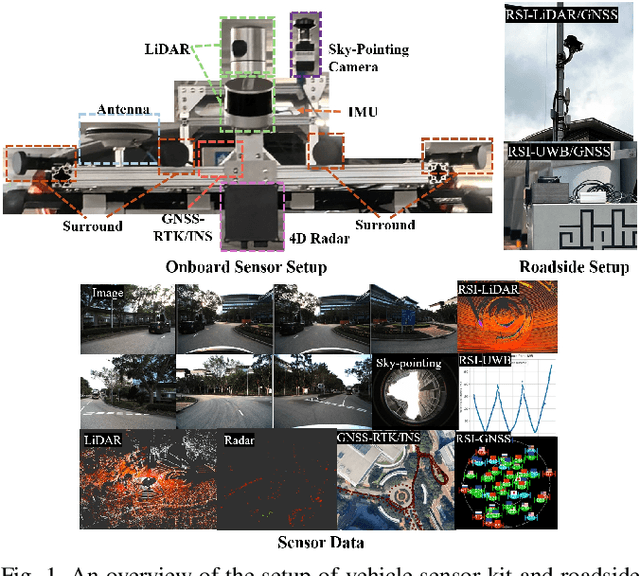
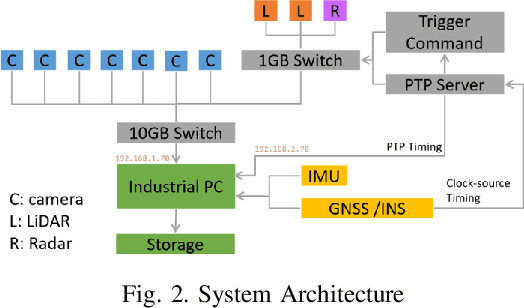
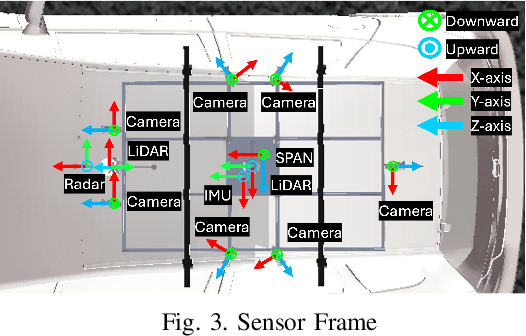
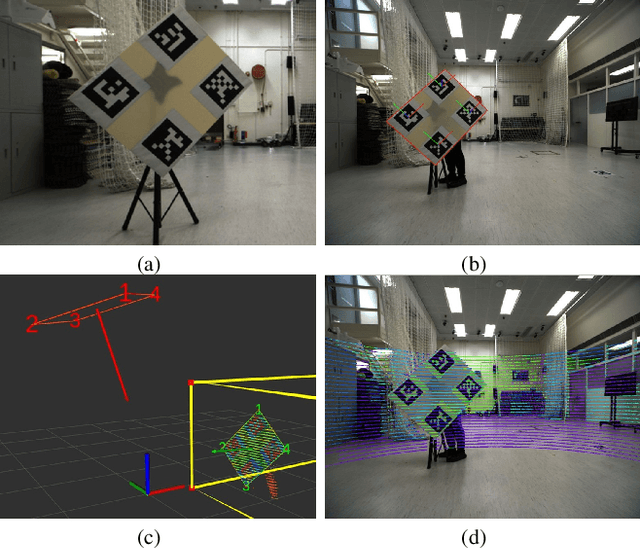
Due to the limitations of a single autonomous vehicle, Cellular Vehicle-to-Everything (C-V2X) technology opens a new window for achieving fully autonomous driving through sensor information sharing. However, real-world datasets supporting vehicle-infrastructure cooperative navigation in complex urban environments remain rare. To address this gap, we present UrbanV2X, a comprehensive multisensory dataset collected from vehicles and roadside infrastructure in the Hong Kong C-V2X testbed, designed to support research on smart mobility applications in dense urban areas. Our onboard platform provides synchronized data from multiple industrial cameras, LiDARs, 4D radar, ultra-wideband (UWB), IMU, and high-precision GNSS-RTK/INS navigation systems. Meanwhile, our roadside infrastructure provides LiDAR, GNSS, and UWB measurements. The entire vehicle-infrastructure platform is synchronized using the Precision Time Protocol (PTP), with sensor calibration data provided. We also benchmark various navigation algorithms to evaluate the collected cooperative data. The dataset is publicly available at https://polyu-taslab.github.io/UrbanV2X/.
Text-IRSTD: Leveraging Semantic Text to Promote Infrared Small Target Detection in Complex Scenes
Mar 10, 2025


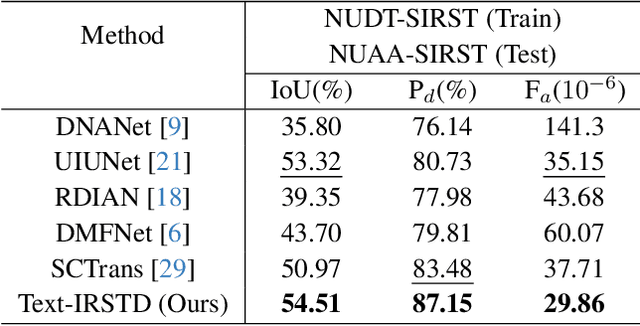
Infrared small target detection is currently a hot and challenging task in computer vision. Existing methods usually focus on mining visual features of targets, which struggles to cope with complex and diverse detection scenarios. The main reason is that infrared small targets have limited image information on their own, thus relying only on visual features fails to discriminate targets and interferences, leading to lower detection performance. To address this issue, we introduce a novel approach leveraging semantic text to guide infrared small target detection, called Text-IRSTD. It innovatively expands classical IRSTD to text-guided IRSTD, providing a new research idea. On the one hand, we devise a novel fuzzy semantic text prompt to accommodate ambiguous target categories. On the other hand, we propose a progressive cross-modal semantic interaction decoder (PCSID) to facilitate information fusion between texts and images. In addition, we construct a new benchmark consisting of 2,755 infrared images of different scenarios with fuzzy semantic textual annotations, called FZDT. Extensive experimental results demonstrate that our method achieves better detection performance and target contour recovery than the state-of-the-art methods. Moreover, proposed Text-IRSTD shows strong generalization and wide application prospects in unseen detection scenarios. The dataset and code will be publicly released after acceptance of this paper.
RAP-SR: RestorAtion Prior Enhancement in Diffusion Models for Realistic Image Super-Resolution
Dec 10, 2024
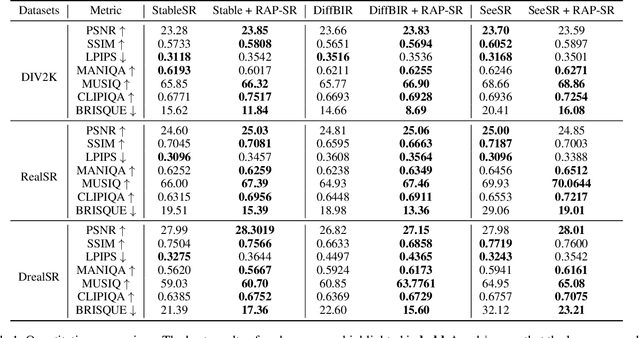


Benefiting from their powerful generative capabilities, pretrained diffusion models have garnered significant attention for real-world image super-resolution (Real-SR). Existing diffusion-based SR approaches typically utilize semantic information from degraded images and restoration prompts to activate prior for producing realistic high-resolution images. However, general-purpose pretrained diffusion models, not designed for restoration tasks, often have suboptimal prior, and manually defined prompts may fail to fully exploit the generated potential. To address these limitations, we introduce RAP-SR, a novel restoration prior enhancement approach in pretrained diffusion models for Real-SR. First, we develop the High-Fidelity Aesthetic Image Dataset (HFAID), curated through a Quality-Driven Aesthetic Image Selection Pipeline (QDAISP). Our dataset not only surpasses existing ones in fidelity but also excels in aesthetic quality. Second, we propose the Restoration Priors Enhancement Framework, which includes Restoration Priors Refinement (RPR) and Restoration-Oriented Prompt Optimization (ROPO) modules. RPR refines the restoration prior using the HFAID, while ROPO optimizes the unique restoration identifier, improving the quality of the resulting images. RAP-SR effectively bridges the gap between general-purpose models and the demands of Real-SR by enhancing restoration prior. Leveraging the plug-and-play nature of RAP-SR, our approach can be seamlessly integrated into existing diffusion-based SR methods, boosting their performance. Extensive experiments demonstrate its broad applicability and state-of-the-art results. Codes and datasets will be available upon acceptance.
Single-Point Supervised High-Resolution Dynamic Network for Infrared Small Target Detection
Aug 04, 2024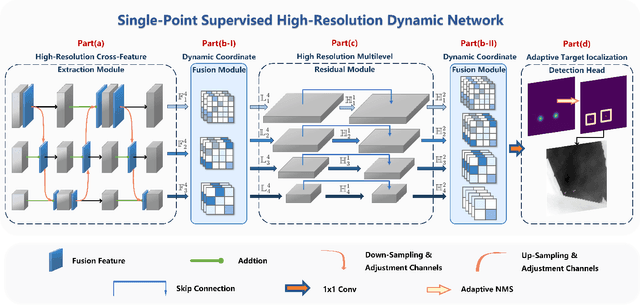
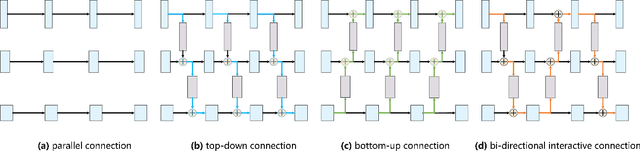
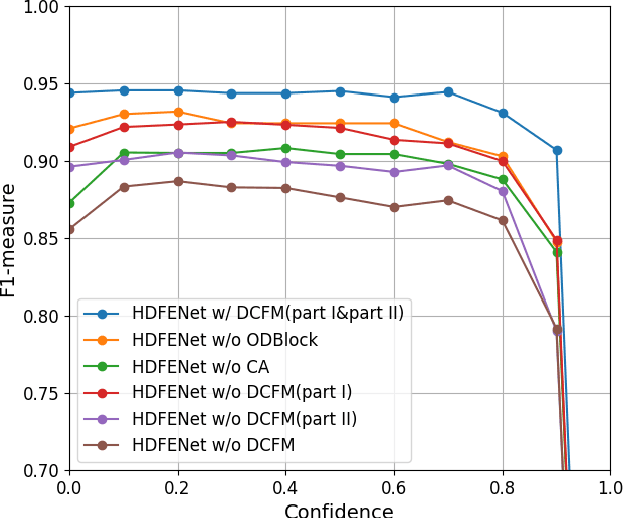
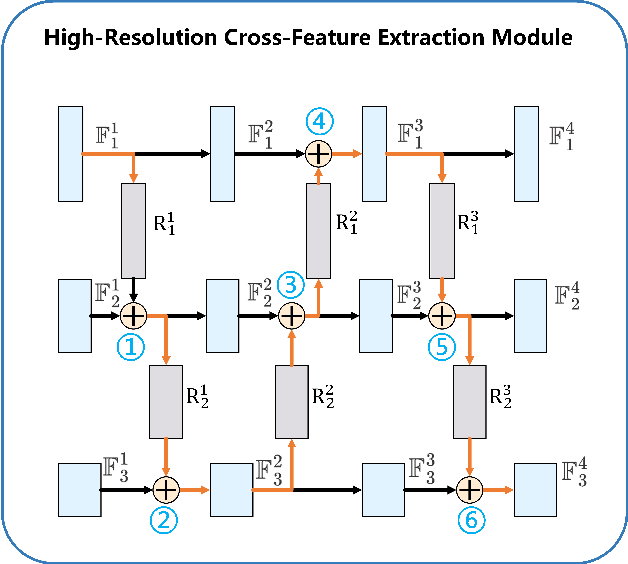
Infrared small target detection (IRSTD) tasks are extremely challenging for two main reasons: 1) it is difficult to obtain accurate labelling information that is critical to existing methods, and 2) infrared (IR) small target information is easily lost in deep networks. To address these issues, we propose a single-point supervised high-resolution dynamic network (SSHD-Net). In contrast to existing methods, we achieve state-of-the-art (SOTA) detection performance using only single-point supervision. Specifically, we first design a high-resolution cross-feature extraction module (HCEM), that achieves bi-directional feature interaction through stepped feature cascade channels (SFCC). It balances network depth and feature resolution to maintain deep IR small-target information. Secondly, the effective integration of global and local features is achieved through the dynamic coordinate fusion module (DCFM), which enhances the anti-interference ability in complex backgrounds. In addition, we introduce the high-resolution multilevel residual module (HMRM) to enhance the semantic information extraction capability. Finally, we design the adaptive target localization detection head (ATLDH) to improve detection accuracy. Experiments on the publicly available datasets NUDT-SIRST and IRSTD-1k demonstrate the effectiveness of our method. Compared to other SOTA methods, our method can achieve better detection performance with only a single point of supervision.
ZeroDDI: A Zero-Shot Drug-Drug Interaction Event Prediction Method with Semantic Enhanced Learning and Dual-Modal Uniform Alignment
Jul 01, 2024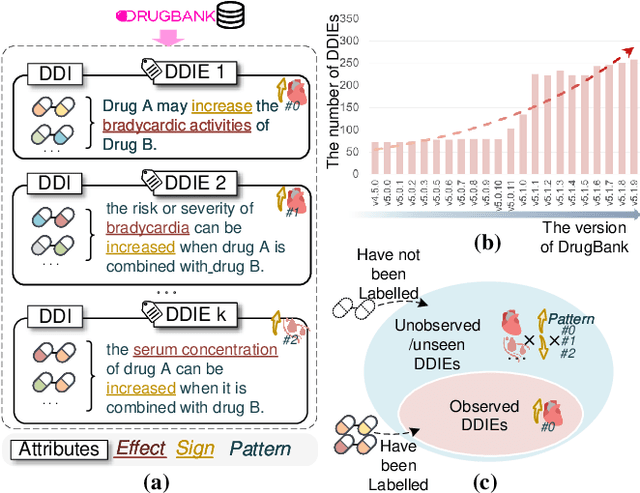
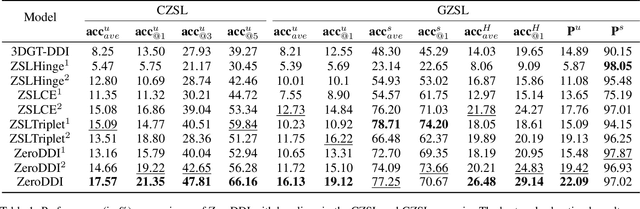
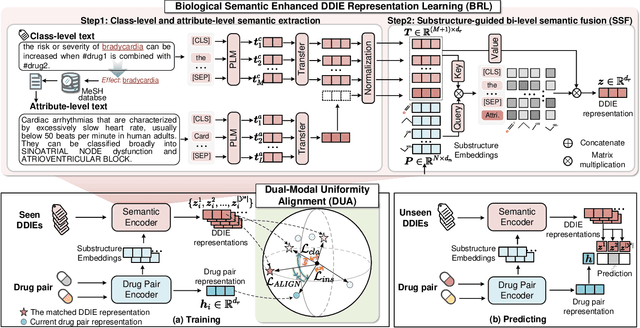
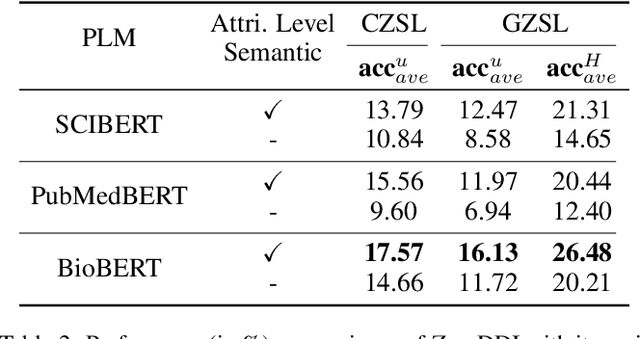
Drug-drug interactions (DDIs) can result in various pharmacological changes, which can be categorized into different classes known as DDI events (DDIEs). In recent years, previously unobserved/unseen DDIEs have been emerging, posing a new classification task when unseen classes have no labelled instances in the training stage, which is formulated as a zero-shot DDIE prediction (ZS-DDIE) task. However, existing computational methods are not directly applicable to ZS-DDIE, which has two primary challenges: obtaining suitable DDIE representations and handling the class imbalance issue. To overcome these challenges, we propose a novel method named ZeroDDI for the ZS-DDIE task. Specifically, we design a biological semantic enhanced DDIE representation learning module, which emphasizes the key biological semantics and distills discriminative molecular substructure-related semantics for DDIE representation learning. Furthermore, we propose a dual-modal uniform alignment strategy to distribute drug pair representations and DDIE semantic representations uniformly in a unit sphere and align the matched ones, which can mitigate the issue of class imbalance. Extensive experiments showed that ZeroDDI surpasses the baselines and indicate that it is a promising tool for detecting unseen DDIEs. Our code has been released in https://github.com/wzy-Sarah/ZeroDDI.